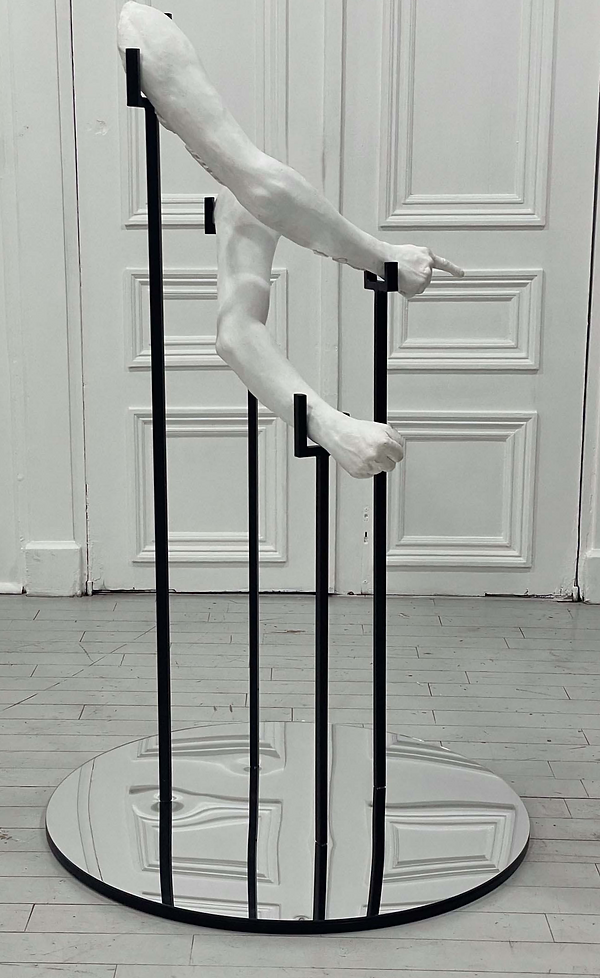
Subdurmal, next to the work of Augustas Serapinas Coup de Théâtre. A Play of Clay, Museum ABBY in Kortrijk (BE)
“Subdurmal”
Sculpture/installation,
Ceramic arms, metal, mirror, 2021-2022
Subdurmal is a series of sculptures in which Jonas Vansteenkiste further investigates the complex relationship between architecture and the human body.
The works consist of ceramic arms mounted within metal uprights, positioned on mirrored surfaces that transform the ground into an active spatial element rather than a neutral support. Through this constellation of materials, the sculptures occupy a fragile threshold between bodily presence and constructed environment.
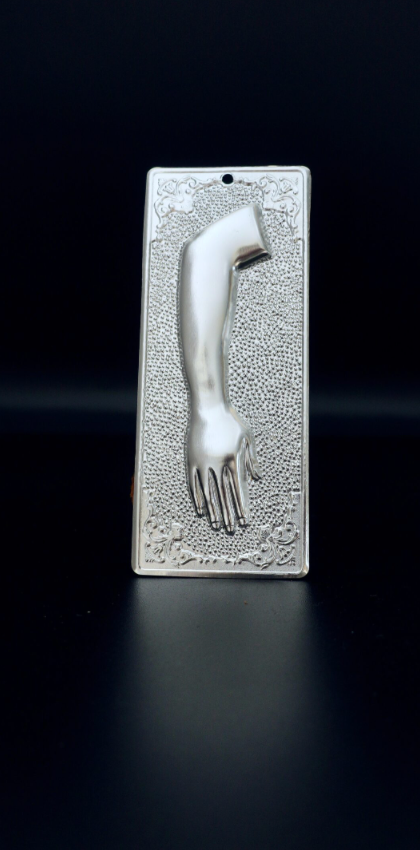
Vansteenkiste approaches this series through the historical and symbolic framework of the ex voto—from the Latin ex voto suscepto, meaning “by virtue of a vow.” Traditionally, an ex voto is an offering placed in a sacred context as an act of gratitude or supplication, often directly connected to a received or desired healing. Such objects were rarely precious in material value; instead, their meaning resided in their intimate relation to lived experience. A healed pilgrim might leave behind crutches rendered obsolete, while morphological ex votos frequently took the form of the body part that had been cured.
Within Subdurmal, this tradition is translated into a contemporary sculptural language. The isolated arms function as fragmented votive bodies—remnants of gestures, carriers of memory, and silent witnesses to invisible transformations. Detached from a complete figure, they appear simultaneously powerful and vulnerable. Their elongated, almost willowy gestures suggest strength and agency, yet their incompleteness renders them uncanny, as if suspended between animation and absence.
Material tension plays a crucial role. The ceramic surfaces evoke skin: delicate, breakable, and marked by subtle traces. Some arms contain small ceramic keyhole forms embedded in or emerging from the surface, while others bear nearly invisible white drawings that allude to fragments of the artist’s personal narrative. These marks operate like scars or inscriptions—signs that resist immediate legibility but suggest hidden histories beneath the surface.
The metal structures supporting the arms introduce an architectural counterforce. They stabilize the sculptures while simultaneously constraining them, creating an ambiguity between care and control. The supports function as both prosthetic extensions and restrictive frameworks, echoing architectural systems that shelter yet discipline the body. This duality reinforces a recurring concern in Vansteenkiste’s practice: the way structures—physical, social, or psychological—shape and condition human experience.
The recurring motif of the keyhole intensifies this ambiguity. Rather than clearly granting access, the keyholes appear to fester across the ceramic skin, raising questions about visibility and concealment. Do they promise entry into an inner realm, or do they instead distort and fragment perception? The viewer is confronted with the possibility of access while simultaneously being denied it.
The mirrored base further complicates the encounter. Reflection multiplies perspectives, implicating both sculpture and spectator within the same visual field. The viewer becomes part of the work’s spatial and psychological construction, confronted with their own body alongside these fragmented surrogates. The mirror thus operates not merely as a visual device but as a conceptual layer, reinforcing themes of introspection, projection, and self-recognition.
The title Subdurmal—literally suggesting something beneath or under the skin—points toward what lies hidden yet formative. It evokes the subcutaneous: layers that remain unseen but fundamentally shape bodily and psychological identity. The piercing-like appearance of certain elements echoes this idea physically, while metaphorically referring to the invisible marks accumulated through personal experience. In Vansteenkiste’s work, these subdermal traces become sculptural signs—manifestations of internal processes that silently mould both body and mind over time.
Through Subdurmal, Vansteenkiste transforms the sculptural object into a contemporary votive form: a space where vulnerability, memory, and structure intersect, and where the body appears not as a fixed entity but as an architecture continuously shaped by what lies beneath its surface.
a special thanks to Arm and hand models: Michaël Vandewalle, Pierluigi Pompei & Jacco Jansen
a special thanks to people how gave me assistants on this project: Steven Putman, Emillia Noordhoek, Stefanie Smith, Anne Van der Velden, Nout Bodyn & Thomas Decuypere
a special thanks to EKWC TEAM :
Katrin König, Mieke Montagne, Pierluigi Pompei, Sander Alblas, Froukje van Baren, Linda Barkhuijsen, Yves Brandsma, Luc Daamen, Annette van den Hout, Debbie Lutter, Tjalling Mulder, Leslie Segeren, Nico Thöne, Ranti Tjan, ...


Subdurmal ,Coup de Théâtre. A Play of Clay Museum ABBY, Kortrijk (BE)